 Suinetwork
 validators: comparing Sui staking options
Updated:Sui validators process transactions and participate in consensus. For native SUI delegation, compare the commission that each validator charges, its operating reliability, and its share of voting power. Commission affects how rewards are shared; reliability can affect how much reward a validator and its delegators receive.
Delegated stake and validator voting power
Sui uses delegated proof-of-stake. SUI holders delegate tokens to validators, and stake helps determine which validators operate the network and their voting power. Validators check proposed transactions and execute those that consensus accepts.
On Mainnet and Testnet, an epoch lasts about 24 hours. The validator committee and its stake remain fixed during that epoch; reconfiguration at the boundary can change the committee and voting power. A quorum holds more than two-thirds of the epoch's total voting power. Validator count alone therefore doesn't describe how voting power is distributed.
Commission and performance affect rewards
The epoch reward calculation combines computation fees with a temporary stake subsidy. Rewards are distributed to validator staking pools, and delegators receive rewards based on the SUI that they've delegated.
- Commission
- Each validator sets the percentage that it takes from delegators' staking rewards. It can change that rate without prior notice; a change takes effect at the next epoch.
- Operating reliability
- Poor validator performance can reduce rewards for both the operator and its delegators. For native delegation, Sui's Security documentation states that user stake can't be confiscated: validator reward penalties leave the delegated principal intact.
When comparing validators with the same reward rate before commission over the same epochs, the validator charging less commission leaves a larger share for delegators. Poorer reward performance can offset that difference, so a commission comparison alone can't establish which operator will deliver a higher return.
When rewards accrue
Each validator has its own staking pool, with exchange rates that the protocol computes at epoch boundaries to account for staking rewards. Native stake earns rewards only for epochs in which it's active for the entire epoch. An unstaking transaction returns the principal and accumulated rewards as SUI.
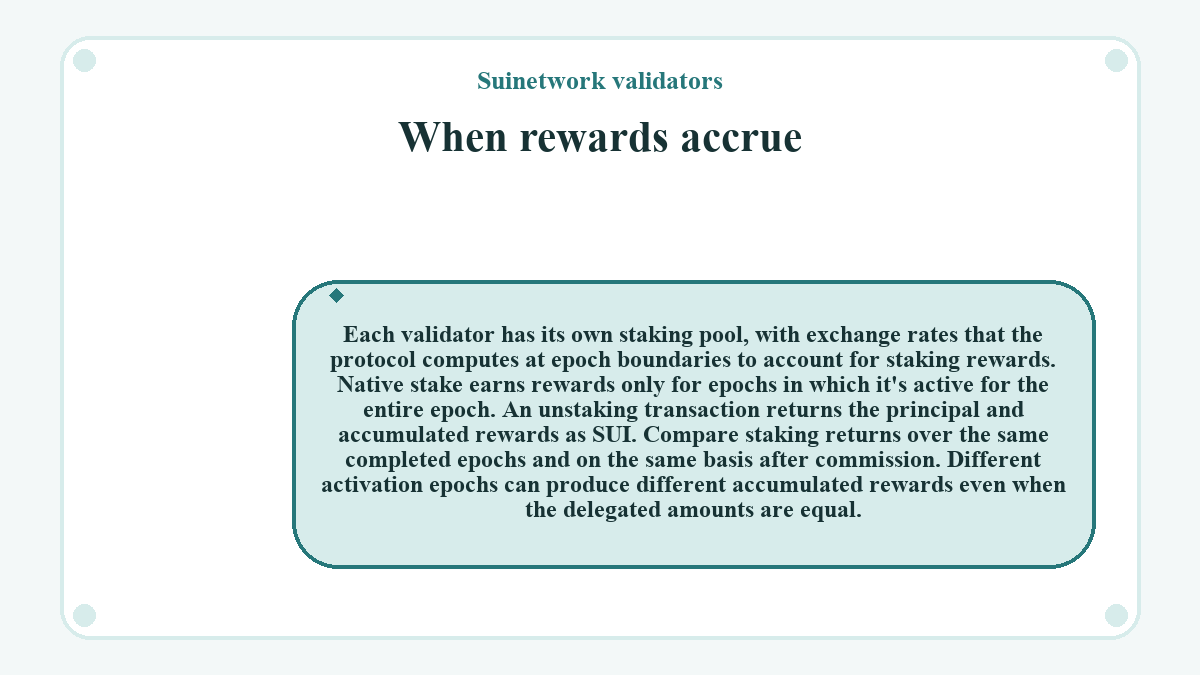
Compare staking returns over the same completed epochs and on the same basis after commission. Different activation epochs can produce different accumulated rewards even when the delegated amounts are equal.
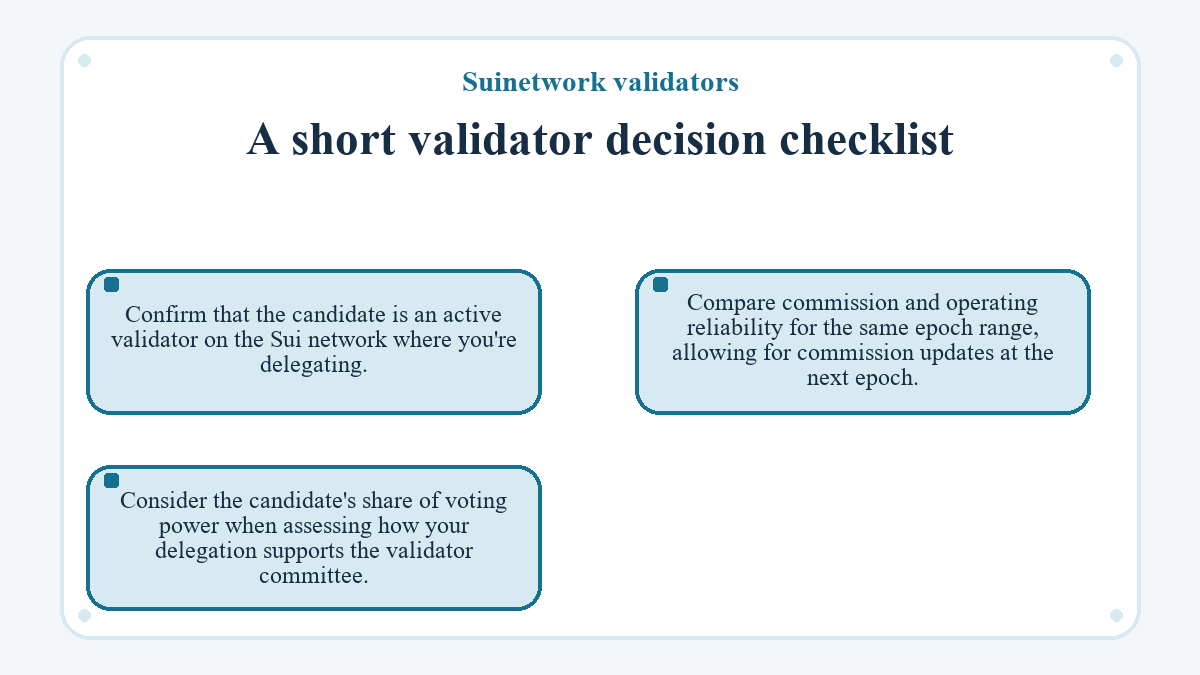
A short validator decision checklist
- Confirm that the candidate is an active validator on the Sui network where you're delegating.
- Compare commission and operating reliability for the same epoch range, allowing for commission updates at the next epoch.
- Consider the candidate's share of voting power when assessing how your delegation supports the validator committee.